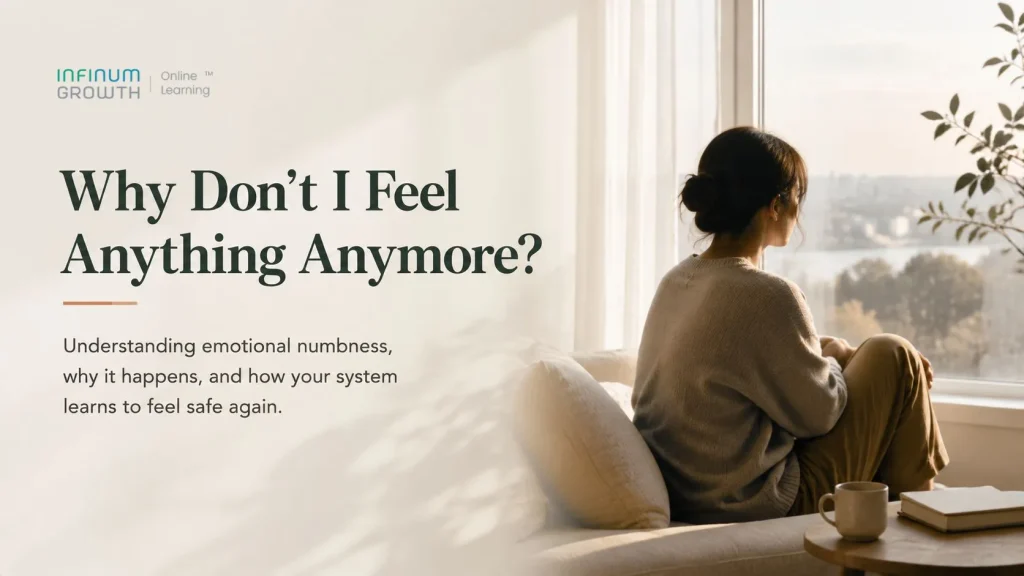

Not feeling anything, even in moments that should move you, is called emotional numbness. It is more common than most people realize, and it is not a sign that something is permanently wrong with you.
You answer the emails. You show up to dinner. Someone tells you good news, or bad news. You wait for a reaction from within. It doesn’t come.
Not sadness. Not joy. Just quiet, where a feeling used to be.
If you’ve been asking what’s wrong with you, here’s something worth knowing first. This isn’t a flaw in you. It’s your nervous system doing something it was built to do.

If you are wondering whether this is what you are experiencing, here is what it actually looks like day to day.
Food that used to be your favourite tastes like nothing. Music you loved doesn’t reach you anymore. Someone shares good news or bad news and you wait for a reaction. It doesn’t come. You go through dinner, work, conversations, present in body but somewhere else entirely. You might laugh at the right moments. But you know it isn’t really landing.
This is not sadness. Sadness has weight and texture. This is the absence of both.
Anhedonia vs. Emotional Numbness: What’s the Difference?
You’ve probably heard the word “anhedonia” before. It sounds clinical, and that’s because it is. But here’s what it actually means: You can’t feel pleasure. And it’s different from what we’ve been talking about.

Let’s compare.
Anhedonia:
Your favorite food tastes like nothing. A song that used to move you doesn’t touch you anymore. Physical closeness that once felt warm now feels like touching a wall. Laughter seems distant. Not sad, just flat. Only your reward system has quieted.
Emotional Numbness:
Your whole range goes quiet. Sadness, joy, anger, love, fear, all of it. Nothing touches you. You’re numb to everything.
Here’s the clearest way to tell them apart:
Anhedonia says: “I want to enjoy this, but I can’t.”
Emotional numbness says: “I don’t feel anything at all.”
They’re Related, But Not the Same
Anhedonia is actually one type of emotional numbness. All anhedonia is numbness, but not all numbness is anhedonia.
You can be completely numb without specifically lacking pleasure, you might feel a flat kind of presence instead. Or you might experience anhedonia where only your reward system has quieted, but you can still feel fear or sadness.
The pattern, though, is identical.
Whether it’s pleasure specifically or everything broadly, your Window of Tolerance has narrowed. Your nervous system has decided to turn down the volume. The question isn’t whether you’re broken. The question is: which part of your system is protecting you, and why?
For some people, the reward center shuts down first. For others, everything goes quiet together. Both are your system saying: “It’s too much right now. I need to protect you by turning this off.”
That protection is the same. The healing process is the same too.
What’s Actually Happening
There’s a simple idea that helps explain this. It’s called the window of tolerance.
Inside that window, you can feel things without being overwhelmed. Sadness is still sadness. But it doesn’t swallow you whole. Anger still shows up. But you can still think while feeling it.
Numbness happens below that window. When stress or pain becomes too much, your system doesn’t always respond with more feeling. Sometimes it does the opposite. It turns the volume down on everything. Not just the pain. The joy too.
This is why numbness feels so quiet, not dramatic. It feels like watching your own life from a few feet away.
You are not failing to feel. Your system made a choice. It decided to protect you by turning things down. It just hasn’t learned yet that it’s safe to turn back up.
Your system makes that choice for a reason.
Why This Happens
Because staying fully open, all the time, isn’t sustainable when too much piles up at once. Shutting down is easier for your system than breaking down. A few things tend to push someone to that point.
Stress that never really lets up is one. Grief that hasn’t had anywhere to go is another. Sometimes numbness shows up not instead of grief, but alongside it, like a holding pattern.
Post-traumatic stress disorder, or PTSD, is another common cause. When the nervous system has been through something overwhelming, an accident, a loss, abuse, or any experience that felt life-threatening, emotional numbness can become a long-term response. The system that was once protecting you during the event keeps protecting you long after it has ended.
For some people, emotional numbness is not caused by stress or grief at all. It is a side effect of medication, particularly antidepressants like SSRIs, which work by adjusting serotonin levels in the brain. While they help reduce pain and anxiety for many people, they can also reduce the full range of feeling, leaving some people feeling emotionally flat rather than emotionally better. This is sometimes called emotional blunting. If you are on medication and notice this, it is worth discussing with your doctor, adjusting the dosage or switching to a different type is often enough to restore the fuller range of feeling.
For some people, this started much earlier. Maybe you grew up somewhere feelings weren’t safe to show. If so, your system learned early that shutting down was the safer choice — and unlearning that often goes faster with the right kind of support, like counselling or psychotherapy, than it does alone.
None of this is a personal failing. Think of a smoke alarm that’s gone off too many times. Eventually, it just stops ringing.
How Transactional Analysis Explains This
Transactional Analysis, the human behavior theory by Dr. Eric Berne, explains this in the following way.
In childhood when we are repeatedly told not to express our feelings, over the years we learn to suppress them. These may show up in different ways – for some it could show as numbness; and for some it could show up as inappropriate feelings in any given situation.
In transactional analysis, our original feelings are called Real feelings; and when the real feelings don’t get expressed, they get replaced by Racket feelings.
Numbness, Guilt, Resentment, Anger, Fear or Sadness etc. are Racket feelings. When we express Real feelings, it’s a release. However, when they get suppressed and replaced by Racket feelings, there’s a sense of being stuck and discomfort.
Over the years, this becomes a pattern. Numbness is a way to protect ourselves without realizing that it’s not helpful.
Learning to identify our real feelings and expressing them appropriately is the first step to healing.
Here’s what that actually looked like for one person.
A Moment That Made This Click
Priya, a client in her early thirties, described it simply. Her best friend had just gotten engaged. She felt nothing. Not happy. Not envious. Nothing at all.
She sat with that for a full week. She was sure something in her had broken for good.
What actually helped wasn’t a technique. It was saying the pattern out loud, with someone else in the room. She learned her system had been running on empty for months. A job loss. A breakup. Back to back, with no real space to process either one.
The numbness wasn’t new information about who she was. It was old stress, finally catching up.
Seeing the pattern like that points straight to what actually helps.
What Actually Helps
Not force, that part first. Forcing a feeling rarely works. It can even make the quiet feel more confusing when nothing shows up on command.
What helps instead is smaller and slower than most people expect. Let a feeling exist for a few seconds, without rushing to distract from it. Reach out to someone you trust, even with a small, low-pressure message.
Move your body, even briefly. A short walk, stretching, anything that brings you back into physical sensation. Your body and your emotional system are connected. One can nudge the other.
Try something you used to enjoy, without expecting to enjoy it. Watch a film you loved. Listen to an old song. Eat something that used to be your favourite. Not to force a feeling. Just to give your system a familiar signal. Sometimes recognition comes before pleasure does.
If you journal, write what you notice, not what you feel. ‘I noticed the coffee was hot. I noticed the room was quiet.’ This is not a trick. It is a way of practising attention when feeling is not yet available.
These aren’t fixes. They’re small signals. They tell your system it might be safe to come back, a little at a time.
For some people, the numbness is not just about the situation itself. It is also about what the situation seems to say about them. Building a steady sense of good self-esteem can be one of the quieter but more durable ways back to feeling like yourself again.
Patience matters here more than people expect. A system that shuts down over months doesn’t usually reopen on a weekend.
For Anhedonia Specifically
Your reward system needs smaller signals.
Watch for: a taste landing, sound breaking through, touch registering, a laugh that surprises you, anticipation appearing. Not pleasure yet just recognition.
Your dopamine system rebuilds slowly. 3-6 months is realistic, signal by signal.
Three Types of Numbness
Numbness from chronic stress:
Your system has been running on empty for months. Everything eventually goes quiet.
Numbness from grief:
Your system isn’t shutting down, it’s holding. This feels different. The timeline is different too.
Numbness from medication (can show as anhedonia):
Some medications dampen your reward system specifically. This is worth discussing with your doctor.
All three look similar. But the cause changes how you heal.
A few more questions tend to come up alongside this one.
FAQ
Question: What does it mean if I don’t feel anything?
Answer: It usually means your system has been carrying too much for too long, and it’s turned the volume down to protect you. It’s not a sign that something is permanently wrong with you.
Question: What does it mean if you don’t feel like doing anything?
Answer: This often goes hand in hand with emotional numbness. When your system shuts down feeling, motivation tends to go quiet too, since both run through the same part of you that’s currently running on empty.
Question: Is it normal to just not feel anything?
Answer: For a short time, yes, especially after something stressful or painful. It becomes worth paying closer attention to when it lasts for weeks and starts affecting your relationships or daily life.
Question: Why am I unable to feel anything?
Answer: Most often, it’s not that you’re unable to feel. Your nervous system has quietly turned itself down, usually after too much stress, grief, or pressure with no real break in between.
Most of the time, this softens with a little patience. But it helps to know when it’s asking for more than that.
When It’s More Than a Rough Patch
Numbness for a few days after something difficult is one thing. But if you have been feeling this way for two weeks or more, if you are going through the motions at work or in relationships without really being present, if the things that used to matter no longer reach you, that is your system asking for more support than time alone can give it.
That is not a sign that something is permanently wrong. It is a sign that the work of coming back is deeper than it looks from the outside.
That kind of support is exactly what a good therapist offers. Not to force feeling back into you, but to help your system learn, slowly, that it’s safe to come back online. If that’s where you are right now, InfinumGrowth’s counselling and therapy team is there for exactly this.

Please do leave your comments at the bottom and do share with others if you like this article.