
Meet Rohan a seven year old boy. He’s working on a math problem. Trying, thinking. But the answer isn’t coming. You see his shoulders tense. You wait. Then it happens. His face goes red. Within seconds, not just minutes but seconds, he’s screaming. Tears flood. He rips the paper. He tells you that you hate him and nobody likes him.
Now meet Priya. She’s also seven. Same math problem. She’s trying too. But when the answer doesn’t come, something different happens. Her shoulders tense. Her body goes very still. Quiet tears roll down her face. She stares at the page without moving.
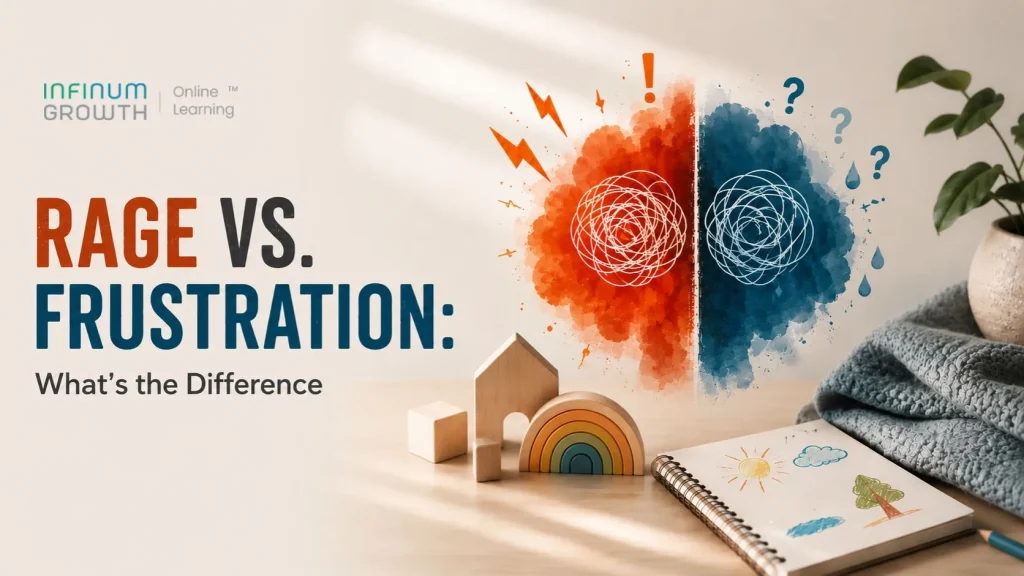
Rohan’s explosion is rage. Priya’s stillness is frustration. They look completely different. They feel completely different. And how you respond to each one matters, a lot.
Because if you respond to Rohan the way you’d respond to Priya, you’ll actually make things worse. If you respond to Priya the way you’d respond to Rohan, you’ll miss what they actually need.

And if you don’t know the difference, you’ll get both wrong.
Difference between Rage and Frustration
We often use “frustration” and “anger” and “rage” like they’re the same word. They’re not.
Frustration is the gap between wanting and having. It lives in the learning space. That place where a child is trying but hasn’t succeeded yet. Frustration is the nervous system saying: “This is hard. I’m uncomfortable.”
Rage is different. Rage is the nervous system saying: “I’m not safe. I need to fight.”

When a child gets frustrated, their body is stuck. When a child rages, their body is flooded.
Frustration happens in the thinking part of the brain. Rage happens in the survival part.
This matters because a parent’s response to frustration, staying present and not rescuing, might actually make rage worse. You need to know the difference.
What Rage Actually Is
Rage in children looks like this. Explosive anger that comes too fast, feels too big, and shuts down reason. The child seems unreachable. They say things they don’t mean. They might hurt themselves or others. It passes, and then shame follows.
A frustrated child cries. A raging child screams like their life depends on it.
Rage is actually the manifestation of intense fear. To name it, acknowledge it and speaking to it helps the child regulate their feelings. Fear, when not acknowledged ort expressed, converts to rage.
Where Rage Comes From
Children don’t arrive angry. It is learned.
Often, it comes from a pattern that started long before this moment. Maybe a child grew up being rescued every time frustration appeared. They never learned to tolerate the gap. Now, when discomfort starts, their nervous system panics. Panic becomes rage.
Or a child learned that frustration isn’t allowed. Feelings weren’t welcomed. So feelings go underground, pile up, and explode.
Or a child was in a home where adults raged. They learned that rage is how you express that you’re overwhelmed. Now they do the same.
Through the lens of Transactional Analysis, we might see a Child ego state in survival mode. Not the playful, curious Child. The frightened Child. The one that learned early: “When things get hard, I’m not safe.”
The Parent Response That Matters
With frustration, the parent’s job is to stay present and not rescue.
With rage, the parent’s job is different. The child needs regulation before anything else.
A frustrated child needs you to calm beside them. A raging child needs you to be calm and boundaried. They need to know you’re not afraid of their anger, but you also won’t let it hurt anyone.
Here’s what this looks like in real moments.
With frustration: Your child tries a puzzle. Can’t fit a piece. Gets quiet. You sit beside them. “This is hard. I’m here.” They stay in their body. They cry softly. The learning space is open.
With rage: Your child tries a puzzle. Can’t fit a piece. Suddenly, screaming. Throws the puzzle. Says you’re mean. Their voice is so loud it sounds like terror.
With frustration, you stay present without fixing.
With rage, you first create safety. You might say: “I see you’re really upset. Let’s take a break. We can come back to this when you’re calmer.” Not as punishment. As protection. Their nervous system needs to come back online first.
You don’t reason with rage. You regulate first. Then, after calm returns, you can talk about what happened.
What Actually Helps
With a raging child, the first step is regulation.
That means the parent regulates first. If you’re flooded too, your child’s nervous system will stay flooded. A calm adult is the greatest gift.
Then, you create safety. Not by fixing the problem. Being steady. Staying present. And by showing through your calmness that this, even this, is survivable.
After rage passes and the child is calm, then you can talk. Not during. Never during.
You might say: “I saw you got really upset. Your body went into alarm mode. That’s okay. But I’m here, and you’re safe.”
Over time, with a parent who stays regulated and doesn’t rescue, rage episodes can become less intense. The nervous system learns slowly. But it does learn. The difference between frustration and rage isn’t about good children and bad children. It’s about which system in the body got activated. Both can be taught. Both can heal.
If rage episodes are affecting your family, reach out. Our counsellors and Psychotherapists help parents and children understand and regulate together.

Please do leave your comments at the bottom and do share with others if you like this article.