


There are times when we know how to help everyone except ourselves.
As therapists, we learn to recognise distress. We know the language of trauma, grief, burnout and compassion fatigue. We notice changes in our clients’ voices, their bodies, their stories. We encourage them to slow down, rest, seek support and make space for what they are carrying.
But sometimes, despite all that knowledge, we fail to recognise what is happening within us.
I know this because it happened to me.

It took me a while to understand that what I was experiencing was not simply a difficult phase of life. I was carrying grief, trauma and emotional exhaustion. Somewhere along the way, burnout and compassion fatigue had quietly become part of my life.
I didn’t recognise them immediately. My body and my sand trays knew before I did.
When Loss Enters the Therapist’s Room
In 2020, I lost a client to suicide.
There are some professional experiences that stay with you long after the session notes are closed and the day is over. Losing a client in this way is one of them.

As therapists, we are trained to maintain professional boundaries. We know that our clients’ lives are ultimately their own. We know that we cannot control every outcome.
Knowing this intellectually does not make loss painless.
I continued working. I continued seeing clients. I continued being there for other people.
And perhaps that was part of the problem.
There was no obvious collapse. Life continued.
Then, in 2021, I lost my beloved pet, Gracias.
Another loss.
And later that same year, I experienced relational trauma.
Three very different experiences. Yet each demanded something from me emotionally.
I was grieving. I was hurting. I was continuing to care for others.
And I was tired. Very tired.
The Difference Between Being Tired and Being Depleted
At the time, I didn’t have the words for what was happening. I thought perhaps I was simply going through a difficult period. After all, therapists are human beings too. We have our own losses, relationships, responsibilities and wounds.
It was during one of my supervision sessions that something shifted. I began to recognise that this was more than ordinary tiredness. There was emotional exhaustion. There was the weight of repeatedly holding the pain of others while carrying my own. There was a sense of depletion that wasn’t being resolved by simply taking a break.
I began to understand that I was experiencing both burnout and compassion fatigue.
Burnout had to do with depletion — the exhaustion that comes when our emotional and physical resources have been stretched for too long.
Compassion fatigue felt different. It was connected to the cumulative emotional impact of caring deeply for people who were themselves hurting.
And suddenly, I realised something that I had often told my clients:
Knowing something intellectually is not the same as experiencing it within yourself.
The Therapist Became the Client
I took what I was experiencing into my own personal therapy. That decision was important.
There can sometimes be an unspoken expectation that therapists should somehow be able to manage their own emotional lives because we know the tools; but being a therapist doesn’t make us immune to pain, grief, trauma and exhaustion.
I needed a space where I did not have to be the one holding everything together. And in that space, I returned to something I already knew intimately: the sand tray.
Sand Tray 1 – When Words Were Not Enough
I had used sand tray therapy in my professional work and had written about how the sand can become a place where the inner world finds a language of its own. But this time, I wasn’t sitting beside a client. I was sitting with my own inner world in the presence of a highly skilled and compassionate therapist.
There was no assignment; no need to make something beautiful, no requirement to understand what I was doing. I simply allowed myself to be.
My first tray was stark. At its centre stood a skull and a pair of bones— large, green and almost alien-like against the expanse of sand. There was nothing else.
Looking back now, I am struck by how little space there was between me and death in that tray. Death had become a presence; not something I was merely thinking about, but something that had entered my emotional landscape. I did not need to explain it. The tray said enough.
Sand Tray 2 -When Everything Feels Like Too Much
My next tray was very different.
There were people scattered across the sand. Some were standing. Others were lying down. The figures appeared disconnected from one another, almost as though each person occupied their own little island of experience.
Looking at the tray now, I see exhaustion. I see people who have fallen. I see a world where there is movement, but very little connection.
At the time, I didn’t necessarily have a neat explanation for what I was creating.
That is one of the gifts of sand tray work. It doesn’t demand an explanation before the experience is ready to be understood. The hands can know before the mind does.
Sand Tray 3 – Finding the Bridges
Then something began to change.
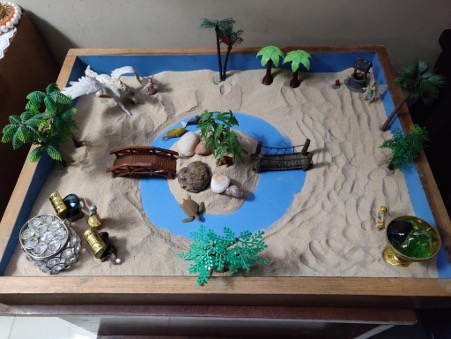
My next sand tray contained water, trees, bridges and living things. There was movement. There was nature. There were pathways connecting one part of the tray to another.
A beautiful winged creature stood on one side. Trees offered shade. Bridges crossed the water. For me, this tray felt different. There was life again. There was connection. There were ways across. A wishing well on one side, and precious treasures on the other.
Perhaps healing doesn’t always arrive as a dramatic transformation. Sometimes it begins with discovering that there is a bridge. A way from one place to another. A possibility of moving.
Sand Tray 4 – The World Beneath the Surface
And then came another tray. A Dinosaur. Insects. A small pool of water. Large creatures stood apart from one another, surrounded by a landscape that felt ancient and primal.
This tray takes me back to something important about healing – that it isn’t always linear. Even after we begin to feel better, old fears and survival responses can reappear.
Sometimes healing means going deeper into the places where we learned to survive.
The dinosaur in my tray now makes me think of something primal — the part of me that doesn’t reason or analyse, but simply asks:
Am I safe?
Perhaps that question had been waiting underneath everything else.
Sand Tray 5 -The Mask and the Light
The final tray in this series felt very different again. There was a mask. There was a woman. There was an image of beauty and femininity. There were objects that felt ceremonial and meaningful. And there were two lamps, both lit. At the centre was a small bowl, held up by a stone.
This tray felt quieter. More contained. There was still complexity, but there was also something that had been missing earlier: light.
Looking back at this series of sand trays today, I don’t see a simple journey from darkness to light. Healing is rarely that neat. Instead, I see a movement. From death to life. From fragmentation to connection. From chaos towards containment. From merely surviving towards beginning to rediscover myself. The sand didn’t magically make everything better. It gave what I was carrying somewhere to go.
What the Sand Taught Me
One of the most humbling parts of this experience was discovering that I could not think my way out of everything. As therapists, we spend a great deal of time using words. We listen. We analyse. We reflect. We make connections. We search for meaning.
But some experiences live below language. Grief can only live in the body. Trauma can only live in sensations. Exhaustion can become a way of being. And compassion fatigue can creep in so gradually that we don’t notice how much of ourselves we have been giving away.
The sand allowed me to stop explaining. I could simply create.
- A skull
- Fallen figures
- Bridges
- Water
- Trees
- Dinosaurs
- A mask
- Light
Each tray became a snapshot of an inner experience that I didn’t necessarily have words for at the time. And because I was not forcing an interpretation, the meaning was allowed to unfold slowly.
The Therapist Needs a Place to Put Down the Weight Too
I wonder if my experience might change the way we look at therapists and caregivers. We often celebrate compassion, empathy and the ability to hold space for others. But who holds space for the person who is always holding space?
Therapists need supervision. Therapists need therapy. Therapists need rest. Therapists need relationships and spaces where they can take off the professional role. Most importantly, therapists need permission to be human.
My experience with burnout and compassion fatigue was not a failure of my professional identity. It was a reminder of my humanity. I cared deeply. I had experienced loss. I had been hurt. I had continued functioning. And somewhere along the way, I had become depleted. Recognising that was not weakness. It was the beginning of self-care.
Finding My Way Back
I don’t believe that healing means returning to an older version of ourselves. Some experiences change us. Perhaps healing is about finding our way into a new kind of reality — one that comes with greater awareness of our limits, our needs and our inner world.
Today, when I look at those sand trays, I see more than miniature figures in sand. I see a journey I could not fully articulate while I was living it. I see the places where I was hurting. I see the places where I was surviving. And I see the gradual emergence of connection, meaning and light.
Perhaps that is what sand tray therapy offered me most generously: It didn’t tell me what I was feeling; it gave my feelings a place to exist.
And once they had a place to exist, they no longer had to remain trapped inside me.
Sometimes, finding our way back does not begin with knowing where we are going. Rather, it begins with giving ourselves permission to stop, breathe, and ask: What is happening inside me?
And sometimes, when the words are not yet there, we can let the sand speak.
When words fail, symbols speak. And sometimes, those symbols help us find our way home.
A Gentle Reminder
Burnout and compassion fatigue can affect anyone who spends a significant amount of time caring for others. If you find yourself feeling persistently depleted, emotionally overwhelmed, detached, or unable to recover through ordinary rest, reaching out for supervision, therapy or other appropriate professional support can be an important act of self-care.

Please do leave your comments at the bottom and do share with others if you like this article.









Very honest and powerful.
Loved the language too
Keep expressing and sharing
Thank you
So well written. In Sanskrit there’s a line “तमसो मा ज्योतिर्गमय” … from darkness to light . This sand therapy probably helps in that direction, with the first step being ‘Know thyself’
Beautifully put, and so deeply relatable Mina.. ❤️ Much respect for how openly you’ve shared your experiences. Sending lots of love!