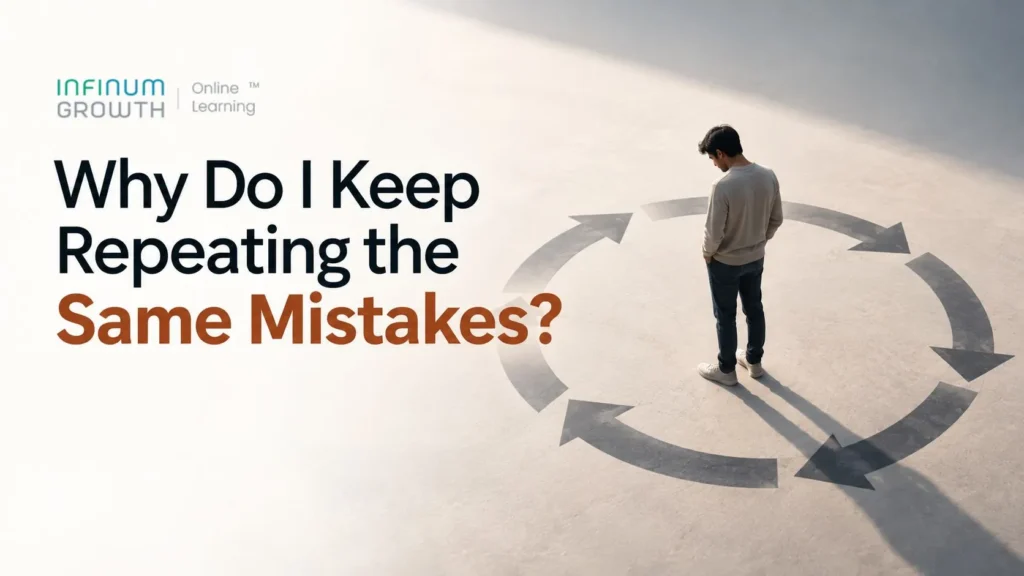

We repeat the same mistakes because most of our actions run on habit, failure hurts our self-esteem so we look away from it, and old patterns still give us small rewards. Many patterns also come from beliefs we formed in childhood. You can break the cycle by noticing your trigger, changing your surroundings, choosing a new response and treating yourself with kindness when you slip.
It is 1 a.m. You are lying awake, replaying the day.
You did it again. The same sharp words with your partner. The same work left for the last night. The same “yes” when every part of you wanted to say “no”.
Last time, you were sure you had learned your lesson. You even said it out loud: “Never again.”

And yet, here you are.
Then comes the quiet voice that hurts even more than the mistake. What is wrong with me? Why can’t I change?
If that voice sounds familiar, you are far from alone. Science has a clear explanation for why smart, caring people fall into the same holes again and again. And the reason has very little to do with willpower.
By the end of this article, you will know why your mistakes keep returning, how to find the exact moment your pattern begins, and the one shift that turns a repeated mistake into real personal growth.

Why Do We Repeat Mistakes Even When We Know Better?
Knowing better and doing better are two different things. Here are four common reasons the gap stays open.
1. Is Habit Making the Choice for You?
Much of daily life happens on autopilot. In one well-known study, people kept hourly diaries of what they did. About 43% of their daily actions were habits, done in the same place, often while their mind was somewhere else (Wood, Quinn and Kashy, 2002).
So when you pick up your phone instead of starting work, you are rarely making a fresh choice. The situation does the choosing. Same chair, same time, same tiredness, same result.
2. Do We Look Away From Our Own Failures?
We like to believe we learn from our mistakes. Research shows it is harder than it sounds.
In 2019, researchers at the University of Chicago ran five experiments with more than 1,600 people. People learned less from their own failures than from their successes. Failing hurts our self-esteem, so we tune out. When the same people watched someone else fail, they learned well (Eskreis-Winkler and Fishbach, 2019).
So the bigger problem is often the looking away.
3. What Does the Old Way Still Give You?
Every repeated mistake gives something back, even if only for a moment. Avoiding a hard conversation brings relief today. Saying yes keeps the peace for now. Scrolling late at night feels like rest.
The cost comes later. The brain notices the quick relief first, so the pattern stays.
4. Are You Following an Old Script?
Sometimes the pattern is older than the habit. Eric Berne, the psychiatrist who founded Transactional Analysis, described something he called a “life script”. It is a story about ourselves that we write in childhood, often without knowing it.
“I must keep everyone happy.”
“I am only good enough when I am perfect.”
“If I ask for help, I am a burden.”
As adults, we keep acting out these lines. The jobs, cities and people change. The script stays the same. You can read more in our article on creating your own life script.
How Do You Spot Your Own Pattern?
You cannot change what you cannot see. This is why self awareness is the first step in any kind of personal growth.
Think of the last time the mistake happened. Then ask yourself five questions:
- Where was I, and what was happening just before?
- What was I feeling? Tired, hurt, anxious, bored?
- What did I tell myself in that moment?
- What did I do?
- What did I get right away, and what did it cost me later?
Do this for two or three times the mistake came back. Soon you will see the same feeling or situation show up each time. That is your trigger.
If you find it hard to see your patterns at all, these signs you lack self awareness may help.
What Does a Pattern Look Like in Real Life?
Ananya works in an office in Pune. Every few months, her manager asks her to take on extra work, and she says yes even when her plate is full. Then she stays up late, feels angry, and snaps at home.
When she wrote down her pattern, she noticed it always began with one small fear: “If I say no, they will think I am not a team player.”
The late nights were only the surface. Underneath sat an old belief.
How Do You Stop Repeating the Same Mistakes?
Should You Promise Yourself “Never Again”?
Psychologist Alice Boyes says that vowing never to repeat a mistake is the wrong approach (Boyes, 2018). It sets you up for shame the next time you slip.
Plan for slips instead. Aim to make the mistake smaller and less frequent.
How Can Your Surroundings Help?
Habits are tied to places and times, so change those. Keep your phone in another room while you work. Pay your bills on the day your salary comes in. Small changes to your surroundings often do more than willpower.
What Can You Do When the Trigger Comes?
Once you know your trigger, decide in advance what you will do instead. For Ananya, it was one sentence: “Let me check my workload and get back to you by evening.”
The trigger stays. The response changes.
Why Does Kindness Work Better Than Shame?
This may sound soft, but research supports it. In four experiments, people who treated their weaknesses and mistakes with self-compassion were more motivated to improve than people who were hard on themselves (Breines and Chen, 2012).
Shame makes us look away. Kindness lets us look closely and learn. Healthy self-esteem helps here too.
When Do You Need Support?
Some patterns come from old hurts, and they are hard to untangle alone. A counsellor can help you see your script and practise new ways to respond. Asking for help is part of growing.
What Is the One Shift That Turns a Mistake Into Growth?
Remember the voice at 1 a.m.? What is wrong with me?
That question keeps you stuck, because it has no useful answer. It only brings shame, and shame makes you look away.
Try a different question: What is this pattern trying to show me?
A mistake that keeps coming back points to something real. A need you have ignored. A fear you have carried for years. An old belief that still makes your choices for you.
When you start asking this second question, the mistake stops being proof that you are failing. It becomes your teacher. That one shift is where personal growth begins.
Key Points
- Repeated mistakes usually come from habits, old feelings and patterns learned early in life.
- About 43% of our daily actions are habits, so many mistakes happen on autopilot.
- Failure hurts self-esteem, so we often look away instead of learning from it.
- Your trigger is the feeling or situation that shows up before each mistake.
- Self-compassion helps you improve more than shame does.
Your Action Checklist
- Write down the last two or three times the mistake happened.
- Note what you felt and told yourself just before each one.
- Name your trigger in one sentence.
- Change one thing in your surroundings that feeds the pattern.
- Decide your new response before the trigger comes again.
- When you slip, ask “What is this showing me?” instead of “What is wrong with me?”
If you would like help understanding your patterns, you can speak with a counsellor at InfinumGrowth.
FAQs: Some questions that may come to mind
Question: Is it normal to keep repeating the same mistakes?
Answer: Yes. Much of what we do each day runs on habit, so repeating mistakes is very common. It points to a pattern you can work on.
Question: Why don’t I learn from my mistakes?
Answer: Failure hurts our self-esteem, so we often tune out instead of looking closely. University of Chicago research found people learn less from their own failures than from their successes.
Question: How do I find out what triggers my mistakes?
Answer: Look back at two or three times the mistake happened. Note where you were, what you felt and what you told yourself. The repeating feeling or situation is your trigger.
Question: When should I talk to a counsellor?
Answer: If the same mistake keeps hurting your relationships, work or health, or feels tied to old pain, a counsellor can help you find the pattern and change it.
Read Next: Building Self Awareness: 9 Steps to Change Life for the Better | RAGE vs. FRUSTRATION: What’s the Difference

Please do leave your comments at the bottom and do share with others if you like this article.