



We treat frustration like a fire alarm – something to rush toward and silence as fast as possible. In our children especially, we see it as a problem demanding an immediate solution. The tears, the resistance, the “I can’t do it” – and we move in. We fix. We soothe. We rescue.
We call it love. And it is. But love without wisdom can quietly work against the very child we adore.
What if frustration is not the enemy of your child’s growth – but the engine of it?
Frustration: Understanding the Emotion
What it actually Is
Frustration is what we feel in the gap between wanting and having. Between trying and succeeding. It lives in the space of “I want – but not yet.” In children, it shows up as tears, tantrums, withdrawal, stubbornness. Not because they are difficult – but because their feelings are larger than their current ability to carry them. It is not a flaw. It is simply what it means to be a child – a human who is still being built.

Dr. Becky Kennedy-The Learning Space
A brief word on Dr. Becky Kennedy
A clinical psychologist and author of Good Inside – named “The Millennial Parenting Whisperer” by TIME Magazine – holds a central belief: every child is good inside, even when their behaviour isn’t. Children’s meltdowns and defiance are not character flaws-they are a signal that their feelings have outgrown their skills.
Dr. Becky describes the gap between not knowing something and mastering it as the learning space. The emotion that lives in that space, without exception, is frustration. And this is not incidental – it is biological. In the moment of struggle, the brain is actively rewiring, building new neural pathways. The frustrated brain is not a stuck brain. It is a brain that is growing.
When we rush to rescue, we do not protect our children from failure. We interrupt the very moment that was quietly making them stronger.

Children don’t need us to remove frustration. They need us to help them tolerate – Dr. Becky Kennedy, The Good Inside
The Beliefs children quietly form due to Frustration
Children are not passive recipients of their upbringing. They are meaning-makers. From their earliest years, they observe how the adults around them respond to difficulty – and they draw deep, wordless conclusions about themselves and the world. Eric Berne called this pattern as the life script – the invisible story a child writes about who they are and what life will give them.
Frustration, more than almost any other emotion, writes powerful lines into that script. Not the frustration itself – but what the adult beside them does in that moment.
Two responses. Two very different life stories.
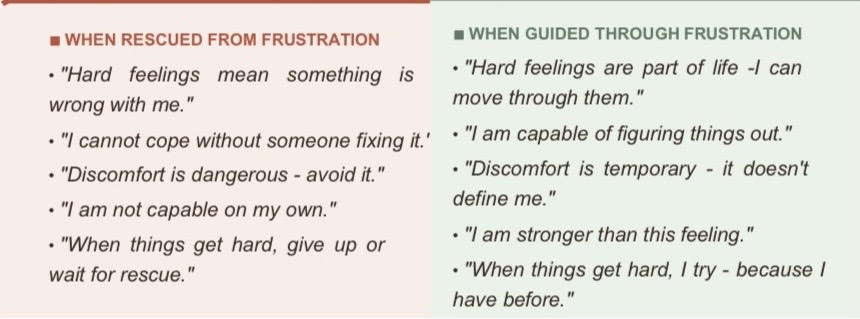
Through the lens of Transactional Analysis (TA)
In TA, we carry an internal Parent ego state shaped by how we ourselves were raised. The Overprotective Parent rushes to rescue – often because their own childhood distress was never tolerated either. The Nurturing Parent stays present without fixing – offering the most powerful stroke a child can receive: I see your struggle, I am not afraid of it, and neither should you be. The difference is not love – both love the child deeply. The difference is the parent’s own relationship with discomfort.
When a parent can sit beside a struggling child – calm, warm, unafraid -without rushing to solve it, something profound is transmitted. The child’s nervous system reads the parent’s steady presence and learns, in its deepest wordless way: this is survivable. That felt knowledge is the foundation of resilience.
What this looks like in real life
1.Regulate yourself first
You cannot offer calm you do not have. Before responding to your child’s storm, notice your own body. Breathe. Your regulated nervous system is the greatest gift you can offer theirs.
Before responding to your child, pause and notice:
- Your breath
- Your body tension
- Your emotional state
Because the truth is simple: You cannot offer calm that you do not have.
When you stay grounded:
- Your tone becomes softer
- Your body signals safety
- Your child’s nervous system begins to settle
Regulation is not about being perfect – it’s about being aware and intentional.
Even a small pause – a breath before reacting – can change the entire emotional outcome.
2. Name it without removing it
When your child is frustrated, resist the urge to jump straight into solutions. Instead, acknowledge the moment:
“This is hard. I can see that. I’m right here.”
This does two powerful things at once:
- It validates the emotional experience without judging it
- It separates the feeling from the need to fix it immediately
Children don’t just need solutions – they need emotional literacy. When you name the feeling, you are helping build the child’s internal language:
“I am frustrated… and I can handle it.” Over time, this becomes their inner voice.
3. Resist the Rescue
Pause before stepping in and ask yourself:
“Is my child in danger or in discomfort?”
This question is transformative.
- Danger requires protection
- Discomfort requires space
Frustration lives in discomfort—and discomfort is where growth happens.
4.Stroke the struggle, not just the success
In TA, a “stroke” is a unit of recognition – what we notice, we reinforce.
Most children grow up hearing:
- “Good job!” (when they succeed)
- Silence (when they struggle)
This creates a dangerous belief: “I am valued for outcomes, not effort.”
Instead, shift your attention:
“I saw you kept trying even when you wanted to stop”. That was frustrating but you stayed with it. Good job!”
Instead of asking, How do I stop this feeling? Begin asking – What is this feeling of frustration trying to build?
Frustration is not the interruption of your child’s growth.
It is the classroom ! And you – just by staying – are the best teacher they will ever have.
To delve deeper , book an appointment with Kaviya Selvaraj at Counsellor/Psychotherapist on InfinumGrowth platform, who will help clear your thoughts in a safe and confidential conversation.

Please do leave your comments at the bottom and do share with others if you like this article.











Very interesting and helpful article with very deep insight on parenting!!!