



Some time earlier, we posted an article on a very important aspect of human behaviour – the Drivers; an important concept from the behaviour theory of Transactional Analysis.
The article, Where are your Drivers taking you? talks about our internal drivers – the embedded messages from childhood that push us to behave in particular ways.
The article got me thinking about the impact of Drivers on Consumer Behaviour and therefore on their customer experience.
Our drivers compel us to act or react in certain stereotypical ways. They will therefore influence our behaviour in everything we do – in our relationships, in our responses to situations we face including, the spontaneous and not-so-spontaneous decisions we take every day.
All consumers belong to particular socio economic, geographic, occupational or Psychographic market segments, which brands need to understand for targeting. Most often, the focus in segmentation is on the socio-economic , geographic or even occupational differences.
But Psychographic segmentation, specially in today’s highly dynamic and diverse societies, could help in connecting with audiences more effectively. In this, one very important element could be the purchase style of an individual, which could be defined by what we could call, their Behaviour Drivers.
Influence of Drivers on Consumer Behaviour
How do my drivers make me respond to my buying needs or to the communication I receive from these brands/marketeers? Would the brands be losing me as a consumer because of my particular behavioural traits, although I fully fit into their target segment definition?
Therefore, how should a brand plan its product positioning and communication to meet my stereotypical behaviour and responses to ensure people like me are not lost to the brand?
To understand this, let’s first look at the concept of Drivers from the theory of Transactional Analysis.
There are five types of Drivers that the article spoke about
1. Try Hard
2. Hurry-Up
3. Be-Strong
4. Be-Perfect
5. Please-Others
Let’s imagine a typical shopping scenario. A man, who normally does not shop for groceries, walks into a shop looking to buy Basmati rice.
Scenarios for each Consumer Behaviour Driver
Here’s what could be the five possible scenarios(amongst others) that could emerge, based on his drivers.
1. Try Hard – Search for the best value for money offering. If not satisfied, try another shop.
2. Hurry-Up – Take the most familiar brand on the shelf, buy it and move out.
3. Be-Strong –Look only for a pre-decided brand. If not available, walk out to try another shop.
4. Be-Perfect – Check out the various options in the market from quality and price perspective. May be even ask for the retailer’s opinion. Then take a well considered decision based on the analysis.
5. Please-Others – Buy a brand which he knows people buy in his social group; Or, submit to the shop salesman’s push; Or may be, just buy after asking his wife.
Of course, a person may have tendencies of not just one, but two or even three drivers.
So a Be-perfect person may also be a Try-hard. For such a consumer, the buying process would be even longer, since he or she would do a thorough research before arriving at the product decision; and then, to ensure buying only that, the try hard would make the person search for the product across shops, if availability is an issue.
Marketing Strategies to respond to Consumer Behaviour Drivers
For marketeers, the following could be some of the actions to handle each of these five types of customers.
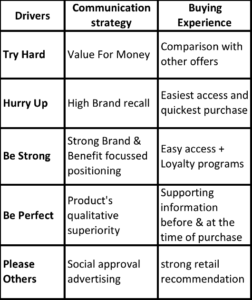
These are not rigid positioning needs for each of the five segments.
It does not mean, for example, that a Be-Perfect never buys a value for money product. However, the consumer’s instinctive choice will be a good quality. When he or she goes for it, while the VFM position may be attractive, the consumer’s information requirements may, therefore, be different.
Product positioning of a brand is defined by the four Ps of marketing; Product, Price, Placement and Promotion.
The core positioning –be it Premium, Value for money, High Tech, High fashion etc is obviously fixed for the brand by the Product, Pricing and the core communication plan.
The handling of Product placement and the accompanying verbal & non-verbal communication– the overall Buying Experience that you offer, could take into account the Driver induced behaviour of consumers.
For example, if a particular product has a Value for money positioning, it may attract consumers of all five Driver types. However, their actions while initiating the buying process may vary.
So a Be-Perfect’s need for detailed product information and a Try-Hard’s need for comparative assessment about the offering will be very different from the Hurry up’s need for a quick buy.
How a brand plans the consumers’ buying experiences may ultimately decide how well it performs across all the five behaviour segments and maximises market share in the overall Target Segment.

Please do leave your comments at the bottom and do share with others if you like this article.








Good article by Sridhar & explained in simple way with apt example including grid.
Great insights, as always, Sridhar! Would you agree that the same product might be targeted at more than one segment thru a different communication channel and messaging? If so, your pricing + promotion strategy might also differ.
I guess so, except that I wouldn’t change the pricing and core positioning communication. I am suggesting readiness at point of sale whether offline or online, to handle different response styles.
Wow – never thought of it like this. Very fascinating. Was reminded of how when I go into a store, I always look at the labels to check for information and rarely buy without comparing prices unless I know exactly what I want. We all are driven to buying by different attributes/drivers. Eye- opener. Nice one Sridhar Rao.
Eyes opened with your article, Sonal:)
Errrr, most people use different strategies depending on the product, the day, and many other things – rather than this woolly concept of ‘internal drivers’. Poor article.
Sridhar, you are absolutely right about the need for marketers to profile customers based on their drivers. The more practical challenge is HOW to do the profiling. This is where Big Data comes in – data science/modeling and analytics will help look at past purchasing behaviors to percolate up to the top segments that may provide the highest “lift”. Of course, this is predicated on the availability of the right type and level of data!