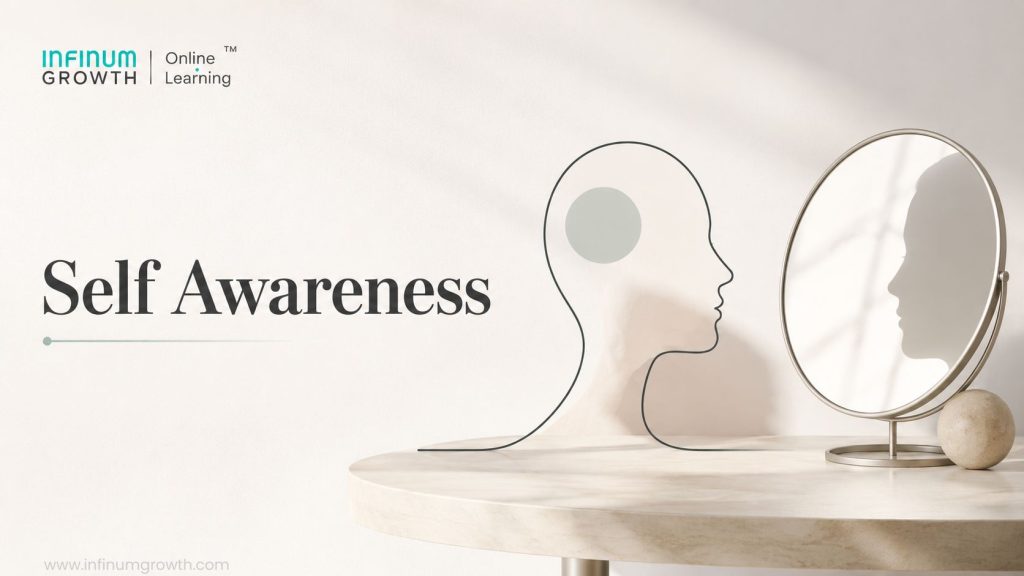

Self awareness is the ability to notice your own thoughts, feelings and patterns of behavior as they happen, and to understand where they come from. It is not the same as overthinking or self criticism. It is simply being able to see yourself clearly, the way a quiet observer would, without judgment getting in the way first.
Most of us assume we already have this. We assume we know why we said what we said in that meeting, or why a particular comment from a friend stayed with us for days. But knowing yourself well enough to actually catch the moment, before the reaction runs the show, is a different skill altogether. It is one that can be built.
In short:
- Self awareness has two directions, understanding yourself, and understanding how others experience you.
- Most people are strong in one and weak in the other, and only 10-15% of people who believe they’re self aware actually are.
- It’s a skill built through noticing and honest feedback, not a fixed trait you either have or don’t.
What does self awareness actually mean?
At its simplest, self awareness has two directions. There is the awareness of what is happening inside you, your needs, your feelings, your reflexive thoughts, often called reflective self awareness. And there is the awareness of how you come across to others, how your tone lands in a room, how your silence gets read, often called social self awareness.
Most people are strong in one and weaker in the other. Someone might know exactly how they feel in a difficult conversation but have no idea how their clipped tone affects the person across the table. Someone else might be acutely aware of how they are being perceived but disconnected from what they are actually feeling underneath it.

Real self awareness asks for both. Not constant self monitoring, which tends to tip into anxiety, but a steady, gentle attention. The kind that notices without needing to fix everything immediately.
What Are the 4 Types of Self Awareness?
Tasha Eurich’s research didn’t just measure how self-aware people are, it also mapped out four distinct patterns based on how much of each kind of awareness someone has.
- Introspectors know themselves well but rarely check how they land with others.
- The Aware have both, they understand themselves and actively value feedback.
- Seekers haven’t yet developed much of either.
- Pleasers are so tuned into how others see them that they’ve lost touch with what they actually want.
Most people recognize themselves somewhere in this list immediately, which is often the first real moment of self awareness itself.
What is the Johari Window and how does it explain self awareness?
One of the most useful ways to picture this is the Johari Window, a framework developed by psychologists Joseph Luft and Harrington Ingham. It divides what we know and don’t know about ourselves into four areas.

There is the part of you that is open, known to you and visible to others. There is the hidden part, known to you but kept private. Then there is the part others can see but you cannot, often called the blind spot. And there is the part neither you nor anyone else has discovered yet.
Self awareness work largely happens in that third quadrant, the blind spot. It is uncomfortable territory because it requires someone else’s honesty, or a moment of unexpected feedback, to shrink it. That discomfort is often exactly why people avoid work, even when they say they want to grow.
What does this look like in real life?
Consider Priya, a manager in her early thirties who prided herself on being calm under pressure. Her team would describe her differently if asked privately. In high stakes meetings, she would go quiet and short, answering in clipped sentences, and her team had learned to read that silence as disapproval, even when she was simply trying to stay composed.
It took a blunt comment from a colleague, who told her that people were starting to walk on eggshells around her during reviews, for the blind spot to surface. Her first reaction was defensiveness. She had never raised her voice. She had never said anything unkind. How could this be how she was experienced?
She sat with it for a few weeks rather than dismissing it outright. She began noticing her own breathing in meetings, the way her jaw tightened, the exact moment her sentences got shorter. Slowly she could see what her team had been seeing all along, not unkindness, but tension that came across as coldness.
She did not become a different person. She started naming the pressure out loud instead of going silent under it, a small shift that changed how the entire room experienced her.
A few smaller, everyday signs of self awareness:
- Noticing you’re about to snap, and choosing not to.
- Catching yourself people-pleasing before the sentence is even finished.
- Recognizing that a strong reaction says more about your history than the moment in front of you.
- Being able to sit with feedback for some time before responding to it.
- Knowing which situations reliably drain you, and planning around that honestly.
Why does self awareness matter for personal growth?
Research by organizational psychologist Tasha Eurich, published in the Harvard Business Review, found something striking after studying thousands of participants. Although the vast majority of people believe they are self aware, only a small fraction, somewhere around 10 to 15 percent, actually meet the criteria when tested. The gap between feeling self aware and being self aware is enormous, and most people never realise they are standing inside it.
That gap shows up in ordinary ways. A few things tend to shift once someone genuinely starts closing it.
- Decisions stop feeling reactive and start feeling chosen, because there is a pause between the feeling and the response.
- Relationships become less confusing, because patterns that used to feel like other people’s problems start to look like shared patterns.
- Feedback stops landing as an attack and starts landing as information, which makes it far easier to actually use.
None of this happens overnight, and it rarely happens alone. It tends to happen in the presence of someone willing to reflect things back to us honestly, a friend, a coach, a therapist, or sometimes simply a quiet, consistent practice of self reflection.
How can I start building self awareness?
The starting point is smaller than most people expect. It is rarely a dramatic insight. It usually begins with noticing.
- Pause once a day and ask what you are actually feeling, not what you think you should be feeling.
- Ask someone you trust how a recent interaction landed for them, and resist the urge to explain yourself while they answer.
- Keep a short note of moments when your reaction felt bigger than the situation called for, and look back at it after a week to see if a pattern appears.
- Notice your body before you notice your thoughts, tension in your jaw, shoulders, or stomach often arrives before you’ve consciously registered what you’re feeling.
- When you catch yourself explaining or defending, pause. That instinct is often a signal worth listening to, not acting on.
None of these require special training. What they require is a willingness to sit with the answer even when it is not flattering.
If you want a fuller walkthrough of specific practices, this piece goes deeper into exactly that.
If you are working through patterns you cannot quite name on your own, that is exactly the kind of work a counsellor or psychotherapist can hold space for.

The Transactional Analysis framework of Dr. Eric Berne has some remarkable concepts that help with exactly this, understanding your patterns, how you acquired them, and how to work at the root to move beyond them.
InfinumGrowth offers quality support from an experienced team of Counsellors and Psychotherapists trained in the Transactional Analysis framework, for exactly this kind of self discovery.
If you wish to understand yourself better, you can also watch the Self Learning Video on Self Awareness “If I don’t know me, who will?”, which explains self awareness through key concepts from Transactional Analysis theory. This video comes with a special discount for a counselling or psychotherapy session at InfinumGrowth.
Frequently Asked Questions
Question: What is the definition of self awareness?
Answer: Self awareness is the ability to clearly notice your own thoughts, feelings, and patterns of behaviour, and to understand where they come from. In simple terms, it means seeing yourself the way an honest, calm observer would, without judgment getting in the way.
Question: Is self awareness the same as overthinking?
Answer: No. Overthinking tends to loop without resolution, replaying the same scenario again and again. Self awareness is the ability to notice a feeling or pattern clearly, once, without needing to spiral through it repeatedly.
Question: Can self awareness actually be learned, or are some people just naturally more self aware?
Answer: It can absolutely be learned. While temperament plays some role, most self awareness comes from practice, honest feedback, and consistent reflection rather than something a person is simply born with.
Question: How long does it take to become more self aware?
Answer: There is no fixed timeline. Small shifts, like noticing a reaction before reacting, can happen within weeks of consistent practice. Deeper patterns, especially ones rooted in childhood or long standing relationships, often take longer and benefit from professional support.
Question: What is the difference between self awareness and self consciousness?
Answer: Self awareness is a clear, fairly neutral understanding of your own thoughts and feelings. Self consciousness tends to be a heightened, often anxious preoccupation with how you are being perceived. One tends to bring clarity, the other tends to bring discomfort.
Question: Is self awareness the same as emotional intelligence?
Answer: Not quite. Self awareness is one piece of emotional intelligence, the foundation Daniel Goleman’s well-known EQ model is built on, but EQ also includes managing your own emotions and navigating relationships with others. You can be highly self aware and still be developing the rest.

Please do leave your comments at the bottom and do share with others if you like this article.