

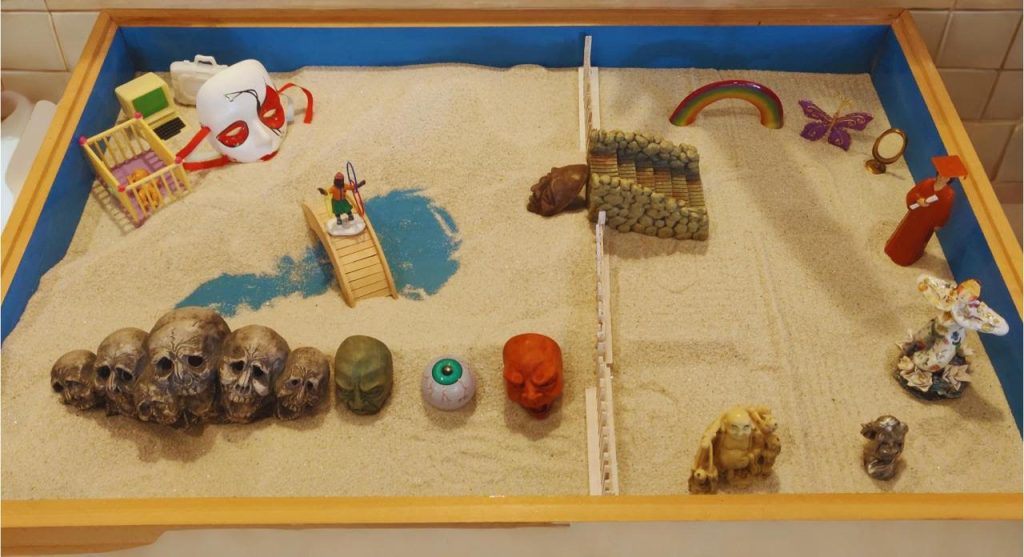

There are moments in life when words fall short.
We may know that something hurts; that something feels wrong or unfinished; yet we cannot quite explain what or why. In such moments, our inner world speaks in images, rather than sentences — through dreams, sensations, memories and symbols.
Sand tray work is one way of listening to this symbolic language.
Originally developed as a therapeutic approach, sand tray play has, over time, revealed itself as something more universal: a gentle pathway into self-discovery. It allows adults to explore their inner landscapes without needing to analyse, justify, or explain themselves.
The hands move, the symbols appear, and meaning unfolds gradually — often in ways that surprise even the person creating the tray.
What Is Sand Tray Play?
In a typical sand tray therapy setting, a person is invited to create a scene using miniature figures — people, animals, natural elements, everyday objects — placed in a tray of sand. There are no instructions on what to create; no expectations of beauty or coherence.
What emerges is not planned; it is revealed.
The sand becomes a container where the unconscious can speak safely. Symbols take the place of words, and the body often knows what to place, long before the mind understands why. For many adults, this feels unexpectedly relieving — as if something long held inside has finally found a form.
When the Inner World Reveals Hidden Truths
One woman in her early forties arrived carrying deep heartbreak after a rupture in her marriage. Talking about it felt overwhelming. Emotions spilled over faster than words could hold. When invited to work with the sand, she chose animals rather than people.
She placed a powerful lion over an ancient dinosaur, heavy and imposing. Nearby, a lioness held a cub gently in her mouth, placed facing away from the lion on the dinosaur.
She did not explain the scene. She only stared at it — and something inside her shifted.
Over several sessions, her trays filled with images of endings: broken hearts, dry trees, skulls and coffins – symbols of finality and loss. Slowly, without being pushed, her understanding expanded. She began to see patterns — not just in her marriage, but in her life. She recognised how she had learned, early on, to survive through adjustment, endurance and denial.
As the weeks passed, the imagery softened. Puppies appeared. Green trees returned to the sand. Flowers, a golden chalice; and eventually, a small candle — steady, quiet, lit.
Her trays reflected what her words could not yet say: grief giving way to acceptance; and acceptance opening the door to clarity and gratitude. The shifts were evident – her breath deepened, her body relaxed, her gaze softened as she slowly, reverentially healed her inner wounds.
When Symbols Unlock the Body’s Memory
Another woman, in her thirties, approached the sand hesitantly. She had always felt an unnamed heaviness, but could not trace its origin. In one session, she placed a tiny baby beside a fierce, fire-breathing dragon.
The moment she looked at the scene, her body reacted before her mind could catch up. Her breath changed. She froze. Memories of abuse long buried surfaced; not as a story, but as sensations and images.
There was no rush to explain or interpret. The work that followed was slow and careful — learning to stay present, to feel safe again, to allow the body to settle, while the symbols held what was once unbearable.
Weeks later, she created a sand tray where the baby sat at the centre, surrounded by angels forming a circle around her. The dragon was no longer visible; it was buried beneath the sand, marked with a tombstone.
That session was a quiet turning point. She began to understand boundaries — not as walls, but as protection. What started in the sand gradually shaped how she spoke, chose and related in her daily life.
When Identity Emerges Through Sand Tray Play
For a woman in her mid-forties, the sand tray became a space of unexpected revelation. She had spent years absorbing messages — spoken and unspoken — about who she should be. Her unmarried status became a source of shame, both internal and external.
In one session, she drew two circles in the sand and placed a pebble in the centre of each. She froze, then gasped.
“It looks like a woman’s breasts,” she said softly.
That image became a doorway. Over several weeks, she returned to it again and again, exploring it from different angles; allowing curiosity where judgment had once lived. Eventually, she created a scene representing a wedding — not the one she had been expected to want, but one that felt deeply true to her – a ceremony where two women united.
The sand tray did not tell her who she was. It simply gave her permission to see herself.
What These Stories Teach Us
A common thread that emerges through these stories is that sand tray play does not force insight. It invites it. It allows grief to surface before meaning, fear to appear before courage; and confusion to exist before clarity. The symbols do not demand interpretation; they ask only to be witnessed.
For adults, this can be profoundly liberating. We are conditioned to explain, rationalise, and move on quickly. Sand tray work slows the process down. It honours the pace at which truth is ready to emerge.
Using Sand Tray Principles in Everyday Life
You don’t need a therapy room to begin listening to your symbolic language. You can start by noticing:
- Which images in books, films, or dreams resonate with you.
- What objects you are drawn to repeatedly and naturally.
- Which symbols feel comforting — and which ones tend to disturb you.
You might try a simple exercise: gather a few small objects that appeal to you intuitively and arrange them on a surface. Don’t analyse. Just observe. Ask yourself gently: What feels alive here? What feels tense? What feels protective?
The answers arrive, not as words, but as a sense of knowing.
A Tender Closing
Self-discovery is not linear. It rarely moves from question to answer, or from pain to resolution. It unfolds in spirals — revisiting old places with new awareness, allowing meaning to surface in layers.
Sand tray play reminds us that our inner world has its own rhythm and language. When we give ourselves permission to listen — without trying to fix, explain or judge — something softens. What once felt overwhelming becomes held. What was fragmented begins to find coherence.
When we learn to trust this process, we discover that growth does not always begin with answers. It begins with curiosity — and with the courage to let the inner world speak in its own time, in its own way.
Like this article? Read another article by Mina Dilip regarding Play
Infinumgrowth provides a range of services for mental health and personal growth. Click here to know more.

Please do leave your comments at the bottom and do share with others if you like this article.








Working as a primary school teacher I have been familiar with the term “sand tray” but never got an opportunity to watch or experience it. But reading this article has given me a view that so far has not come to my mind. A simple play tool is enabling a complex human being to express certain things which cannot be done with words or where words will not be sufficient enough to express their inner emotions!
This is such a mind opening article where every individual should know about this play tool and especially if they are a parent they need to be conscious enough to give their child such opportunities and space to express their thoughts! Atleast that’s the bare minimum which they can provide in this stressful world!
Very well written article.Sand tray therapy seems to have helped unburden & heal many people.My whole hearted appreciation to Mina Dilip for the wonderful & soulful job of helping to heal many from their hidden traumas.
I found this article truly enlightening and beautifully written. It offers a very clear and in-depth explanation of how sand tray work functions — especially how it allows people to express inner experiences when words alone are not enough. The way the author explores the symbolic language of sand tray play helped me appreciate both the therapeutic depth and the gentle power of this activity. Overall, it’s a thoughtful and insightful piece that deepens understanding of expressive therapeutic approaches. Thx Mina. It’s brilliant
Excellent article, well written with cases. It unfold the depth of the power of symbolism in hubsn psyche. Thank you Mina.
Its an excellent article, Mina. A thoughtful piece that helps understand the reality of expressive therapeutic approach. Good luck.
Thank you everyone, for taking the time to read the article and also share your thoughtful comments and feedback!
I found your article both articulate and deeply resonant. You conveyed the essence of sand play therapy with nuance, especially the way it creates space for nonverbal expression and integration. It’s a valuable contribution to the field and invites richer conversation about how we support clients through creative, embodied approaches.
I found your article both articulate and deeply resonant. You conveyed the essence of sand play therapy with nuance, especially the way it creates space for nonverbal expression and integration. It’s a valuable contribution for people to understand this sand therapy as a therapeutic practice.
This was really interesting to read Mina! As an observer, it is fascinating to see how meaning unfolds through symbols and space rather than words. You have explained it so clearly.
Loved the emphasis on safety and expression beyond words.
Very interesting and insightful. Yes, our feelings and truth do express themselves in ways we don’t pay attention to. This shows how paying attention to these non-verbal communication can improve our relationships, including with oneself.
Well written Mina. You have managed to capture the essence of the modality in a single article. I thoroughly enjoyed your writing style and your skill as a therapist is evident through your examples. Sand tray is a potent tool and your passion patience and (gentle) presence is commendable. Kudos.
The articles are fantastic. I am hearing about Sand Tray Play therapy for the first time. I’m filled with curiosity to learn even and use in my career. I’m interested to know how our human mind uncovers and seek what it really needs.
Wonderful article .
Heard about sand tray play , but not known that much detail. Thanks to Mina . Its a eye opening
I thought sand tray play therapy was only for children. After reading this article, I am truly impressed about the therapy.
I admire your knowledge sharing and articulation Mina.
Such a beautiful article on sand tray play by Mina Dilip. Especially these lines have stayed with me – It allows grief to surface before meaning, fear to appear before courage; and confusion to exist before clarity.
So profound & articulate. Thanks for also including helpful tips on implementing this in everyday life.
A very insightful and informative article. It is a revelation. Beautifully worded and inspiring.
Thank you all for your comments and feedback! I am humbled and inspired to write more!