At some point in midlife, the milestones we worked toward stop feeling sufficient on their own. The titles, the houses, the goals we ticked off… they matter, of course.
Many people in midlife have done what they were expected to do. Careers have been built. Responsibilities carried. Children have grown up. Life, in many ways, looks good. And yet, something still feels incomplete.
Midlife: When reflection starts with questions from within
Do I want the next decade to look exactly like this?
What part of my life still feels alive and growing?
What am I doing out of habit, and what still genuinely matters to me?
Midlife is not always a crisis. Sometimes it is simply a reassessment.
There is a growing need for work, relationships, and contribution to feel more connected to who they are now..
Carl Jung’s concept of Individuation
I have written earlier about Vanaprastha, that stage in Indian tradition when one moves from striving to reflection. I have also explored Erik Erikson’s idea of Generativity versus Stagnation, where the big question becomes not “What do I get?” but “What do I give?”
For this piece, I draw from Carl Jung.
Carl Jung, the Swiss psychiatrist and founder of Analytical Psychology, believed that life changed in meaningful ways as we moved through different stages.

He called this process individuation, bringing together who we are on the outside with who we truly are inside.
He saw a clear divide:
- The first half of life is about adapting to the external world. Education, work, family, achievement, identity.
- He believed the second half of life, particularly midlife and beyond, was about individuation: turning inward, integrating neglected parts of ourselves, and moving toward wholeness.
As he put it:
“The afternoon of life must have a significance of its own and cannot merely be a pitiful appendage to life’s morning.”
The four stages of this midlife journey
Contemporary Jungian writers often describe this journey in four stages:
- First comes the Athlete, when we live through the body. Strength, beauty, vitality.
- Then the Warrior, when ambition takes over. Proving ourselves, building, striving.
- Next is the Statement, when the question shifts: who am I beyond what I have done?
- Finally, the Spirit, when the search turns toward wisdom, connection, and giving back.
Many people in midlife find themselves standing at that passage between Warrior and Statement. We have carried responsibilities. We have proven what we needed to prove. And yet, something nudges us to ask: is this still the point?
For some people, this shows up as a desire to slow down. For others, it appears as restlessness, a feeling that life has become too repetitive or overly defined by responsibility. Some begin wanting to build something new. Others want more space, more meaning, or just a different relationship with work and time..
In many of our conversations we have had at Zuva Life, people rarely say they are in transition. They usually speak about exhaustion, restlessness, or feeling strangely disconnected from things that once mattered deeply.
Life on the whole looks normal but underneath the daily routines, many people are sitting with questions which they don’t speak about openly. What kind of life do I want from here? What still feels meaningful? What am I carrying simply because I always have?
These questions may show up differently for different people, but they seem deeply connected to what many thinkers have tried to describe about midlife over the years.
What really strikes me is that Jung, Erikson, and even the idea of Vanaprastha are all pointing toward a similar shift in midlife. A movement away from proving and toward questioning what really matters now.
Upcoming Retreat program for Midlife Transitions by Zuva Life
At Zuva Life, much of our work begins with these questions. We increasingly see midlife not simply as a stage of maintenance, but as a period where people begin relooking at their identity, contribution, relationships, and direction.
Our upcoming retreat, Making Sense of Your Transitions has been designed around this phase of life.
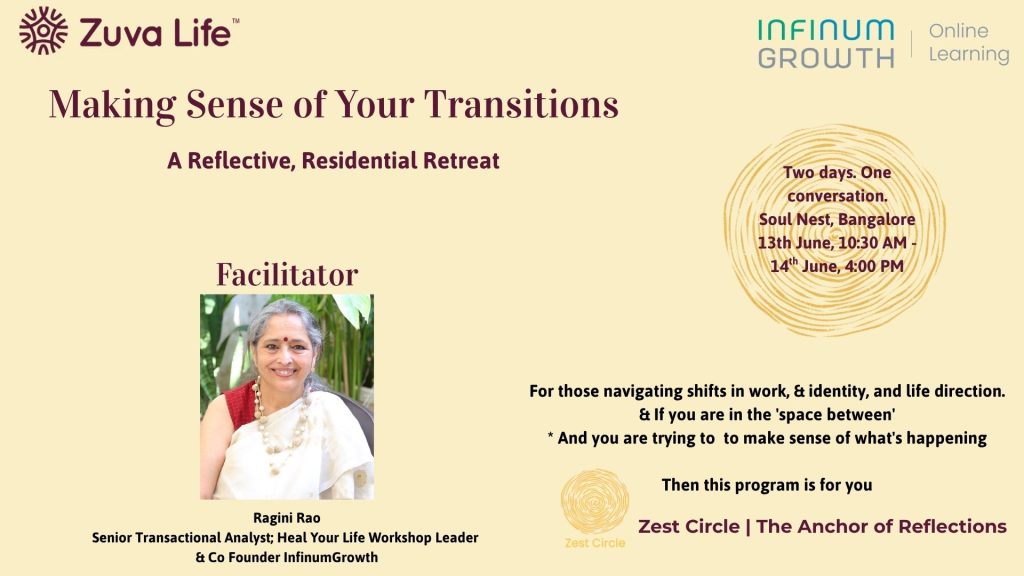
A small space for people who want to step away from routine for a couple of days and think more clearly about where they are in life and what may need to change.
So, here are a few question for all of us to hold
- What’s one thing we are ready to leave behind?
- And what new self are we ready to grow into?
Sometimes, the first shift in midlife is simply about becoming more honest with ourselves.

Please do leave your comments at the bottom and do share with others if you like this article.